


Nature Has a Way: A Juneberry Story
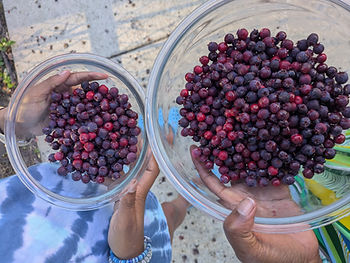
It started with a bribe. "Come with me to pick some berries. I'll give you some ice cream." My daughter barely looked up from her video game. Now, to be fair, Juneberries are not a mystery to her. She has picked them before. She has tasted them. She knows exactly what they are. The screen had her full attention, and I was standing there holding a bowl and making promises about ice cream.

Eventually, she came. And once again, nature did what nature always does, it pulled her in.
It is Juneberry season, and if you have never heard of Juneberries — also called serviceberries or Amelanchier — let me introduce you to one of the most underappreciated fruits growing right in your neighborhood. These small, blueberry-like berries ripen in late May through June, depending on your region, and they are absolutely worth seeking out. In fact, there is a good chance they are already growing near you, because Juneberry trees are a popular choice for urban landscaping. They are subtle. They are seasonal. And they are stunning.
Nutritionally, Juneberries are a quiet powerhouse. They are rich in anthocyanins, the deep purple pigments that give them their beautiful color and deliver potent antioxidant activity in the body (more than blueberries, strawberries and raspberries)! They also provide iron, an important mineral for energy and oxygen transport, as well as manganese, copper, and a solid dose of dietary fiber. Their vitamin C content supports immune function and collagen production. For those of us who think about food as medicine, Juneberries are a small berry with a big resume. If you want to try them, make sure to hurry them only last 1-2 weeks!
Back to my daughter. We walked to a Juneberry tree in our neighborhood. It's one of those beautiful trees that most people walk past without a second glance. As a matter of fact, several people gave us quizzical looks wondering what we were doing.
I started picking, pointing out the ripest ones, the ones that give just slightly under gentle pressure, the ones with the deepest color. She watched. Then she picked one. Then another. And then something shifted. Within minutes, she was fully invested. Reaching for branches and tasting as she went. My son wandered over for a bit too, drawn in by curiosity the way children always are when something real is happening right in front of them. But my daughter? The video game was a distant memory. She was gone. Fully captured. I watched her pick berries with a focused attention. This is exactly it. This is why I talk about urban agriculture, food literacy, and connecting people back to the land. Not because it is a nice idea. Because nature has a way of entrapping even the most hesitant among us. You just have to get them close enough to touch it.
She went back inside to grab another bowl. Not for the ice cream. For more berries. She came back with a purpose and a plan: Juneberry infused sparkling water. She muddled the berries, added a little sugar and poured it over sparkling water — completely on her own terms, in her own way. And then she served it. To everyone. At dinner. She stood at that table and poured out little glasses of her Juneberry concoction, and we all took a sip. Watching her take full agency over that project from the tree to the table, that was everything. That was the whole lesson in a single moment.
As for the rest of the berries? I made jam. A simple, beautiful Juneberry jam that I showcased on Instagram, you can watch the video here.
The next time someone tells you they do not connect with nature, I want you to think about my daughter. Think about how it took exactly zero lessons, zero curriculum, and zero convincing once she was standing beneath that tree with a berry on her tongue. Nature does not need a sales pitch. It just needs proximity. Find your Juneberry tree. Take someone with you. Offer ice cream if you have to. 🫐✨

Want to learn more about foraging, food literacy, and eating with the seasons? You are in the right place.


Comments